 Meridian
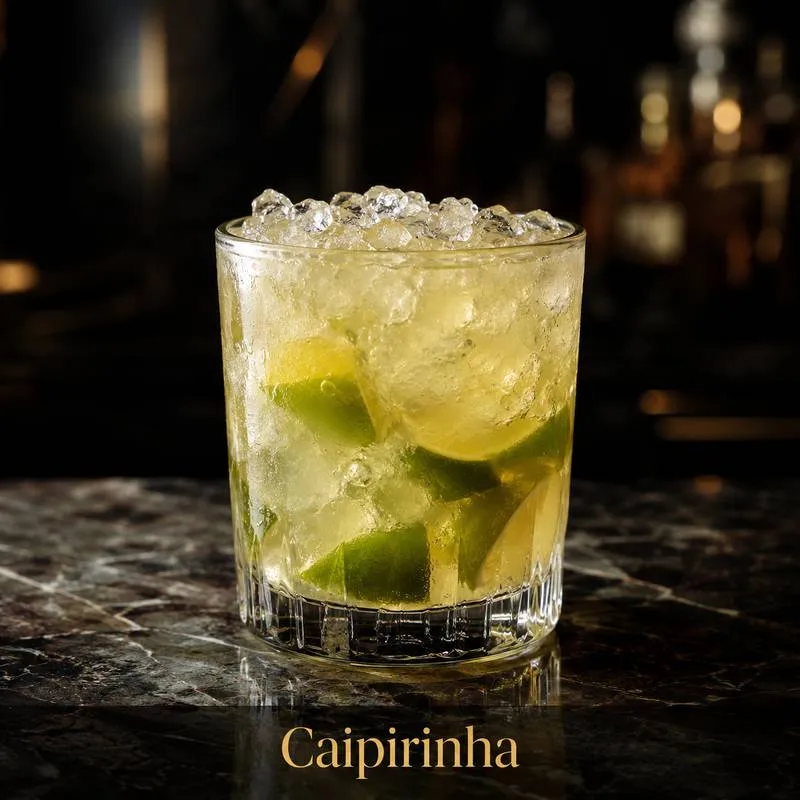
Caipirinha Cocktail Recipe from Brazil
Pronunciation: ky-pee-REEN-ya · Origin: Brazil · Glass: Rocks Glass · Difficulty: Beginner · Strength: about 19% ABV · Serve: Cold (2 to 6°C / 36 to 43°F) · Style: Flat · Era: Pre-Prohibition · Flavour: Citrusy, Funky, Sweet, Tropical, Vibrant
What it tastes like
Vibrant and tropical: cachaça’s grassy, funky sugarcane character is brightened by the tartness and aromatic oils of fresh lime skin, while demerara sugar adds a molasses warmth that balances without over-sweetening. Rustic, alive, and unmistakably Brazilian.
Ingredients
- 60 ml (2 oz) Cachaça
- 1 piece Fresh Lime (cut into 8 wedges)
- 4 tsp Demerara Sugar
- 1 cup Crushed Ice
Method
- Cut a whole lime into 8 wedges, removing the white central pith if possible to reduce bitterness.
- Place the lime wedges in a rocks glass (not a shaker) with the demerara sugar.
- Muddle firmly 8 to 10 times, pressing and rotating the muddler to extract the juice and oils from the lime skin: the skin’s oils are essential.
- Add crushed ice to fill the glass.
- Pour the cachaça over the ice.
- Stir well from the bottom to integrate the sugar, lime, and cachaça.
- Top with a little more crushed ice and serve with a short straw.
Sourcing the ingredients
Sourcing difficulty: Moderate
Cachaça (pronounced ka-SHA-sa) is a Brazilian sugarcane spirit distilled from fresh cane juice rather than molasses, giving it a grassy, funky character distinct from rum. Quality brands available internationally include Leblon, Novo Fogo, and Ypióca. Do not substitute rum: the flavor profile changes entirely.
History
Brazil’s national cocktail is most often dated to around 1918 in the interior of São Paulo state, though some historians trace it to 19th century farmers around Piracicaba. Its exact origin is unknown. A popular but unverified story holds that the Caipirinha evolved from a folk remedy for the Spanish flu pandemic of 1918, made with citrus, garlic, and honey, and that removing the garlic and honey and adding sugar produced the modern Caipirinha. The drink’s name derives from ‘caipira’, a Brazilian colloquial term for a country person or peasant, and the diminutive suffix ‘-inha,’ meaning ‘little.’ The drink was drunk by working-class Brazilians for decades before being formalized and promoted internationally.
Brazilian law protects the name cachaça for spirit made in Brazil, a definition the United States accepted in 2013.
Cultural significance
The Caipirinha is Brazil’s most important cultural export in drink form. It is inseparable from Brazilian national identity: the cachaça represents the country’s agricultural and Afro-Brazilian heritage, the lime its tropical abundance, and the sugar its plantation history. The drink is consumed at every level of Brazilian society, from beach shacks to fine restaurants, and is synonymous with the joy, sensuality, and warmth of Brazilian life. Brazil’s legal protection of cachaça as a uniquely Brazilian spirit, recognized by trading partners such as the United States in 2013, gave the Caipirinha a legal framework loosely analogous to France’s protection of Champagne, and helped grow cachaça into an internationally recognized premium spirit category.
Food pairings
- Grilled tropical fruit
- Coconut shrimp
- Ceviche
- Plantains
Get Meridian
Keep all 888 drinks from 141 countries in one app: search any drink by name, browse by country, filter by flavour, switch between ml and oz and save your favourites. One price, no ads, no account, and it works offline.