 Meridian
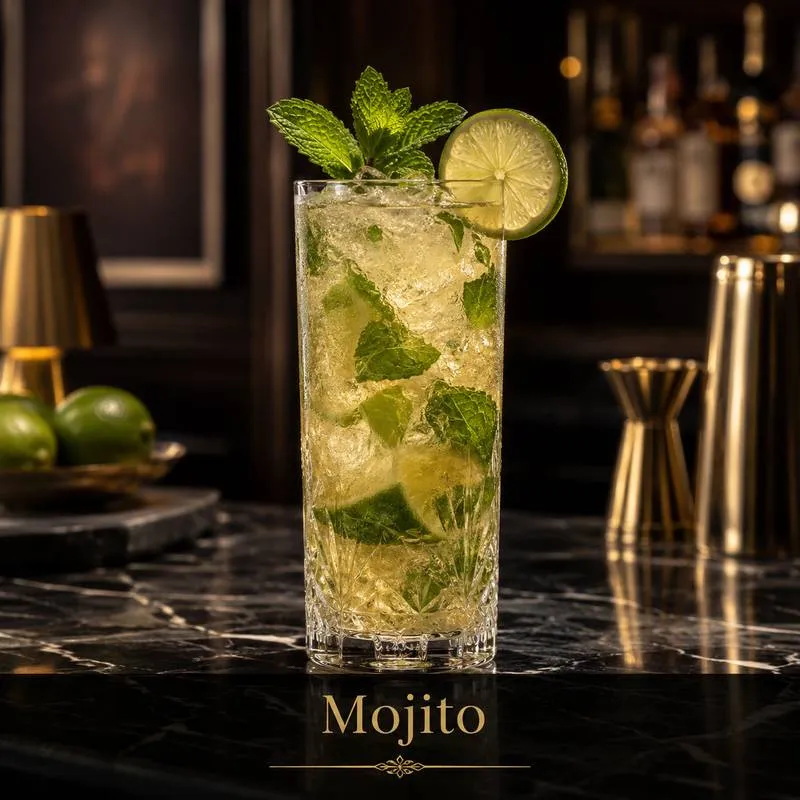
Mojito Cocktail Recipe from Cuba
Pronunciation: moh-HEE-toh · Origin: Cuba · Glass: Highball Glass · Difficulty: Beginner · Strength: about 12% ABV · Serve: Cold (4 to 7°C / 39 to 45°F) · Style: Sparkling · Era: Victorian · Flavour: Minty, Citrusy, Sweet, Effervescent, Herbaceous
What it tastes like
Refreshingly cool and aromatic: mint leads the nose, followed by bright citrus and a clean sweetness, with effervescence from the soda making it feel light and sessionable. The rum stays subtle in the background.
Ingredients
- 60 ml (2 oz) White Rum
- 30 ml (1 oz) Fresh Lime Juice
- 20 ml (0.75 oz) Simple Syrup
- 10 leaves Fresh Mint Leaves
- 60 ml (2 oz) Club Soda
- 1 cup Crushed Ice
- 1 sprig Mint Sprig (garnish)
- 1 slice Lime Wheel (garnish)
Method
- Place mint leaves and simple syrup in the bottom of a highball glass.
- Gently muddle the mint (press and twist, do not shred) to release the aromatic oils without bruising the leaves bitterly.
- Add fresh lime juice and white rum.
- Fill the glass with crushed ice, pressing it down firmly.
- Top with cold club soda and stir gently from the bottom up with a bar spoon to integrate without losing carbonation.
- Garnish with a fresh mint sprig (slap it against your palm first to release its aroma) and a lime wheel.
Sourcing the ingredients
Sourcing difficulty: Easy
Fresh mint is the only perishable ingredient: it is widely available year-round at supermarkets. Choose spearmint over peppermint for an authentic flavor. All other ingredients are pantry staples.
History
The Mojito’s ancestry may reach back to the 16th century, when Sir Francis Drake’s fleet anchored off Havana. A primitive version called ‘El Draque’, made with aguardiente (a rough cane spirit), lime, sugar, and mint, was, according to legend, used as a medicinal remedy for scurvy and dysentery among sailors. The Drake link is a theory rather than documented fact. The first firm evidence comes in 1833, when the writer Ramón de Paula described drinking a daily ‘Drake’ made from aguardiente, and a 1940 account holds that once aguardiente was replaced with rum, the Drake came to be called the Mojito. The drink first appears in print under the name Mojito in the Sloppy Joe’s Bar souvenir menu for the 1931 to 1932 season. Who first made it, and when, is not documented.
Like the Daiquiri, the Mojito gained international exposure through Hemingway and the vibrant Havana bar scene of the 1920s to 1940s. La Bodeguita del Medio in Old Havana became its spiritual home, with the famous (though possibly apocryphal) Hemingway quote adorning its walls: ‘My mojito in La Bodeguita, my daiquiri in El Floridita.’
Cultural significance
The Mojito is Cuba’s unofficial national cocktail and a symbol of the island’s cultural vitality and creativity. It is often seen as an expression of Cuba’s mixed Spanish, African and Caribbean heritage. Globally, the Mojito experienced a massive revival in the 1990s and 2000s, becoming one of the world’s best-selling cocktails. It introduced an entire generation of drinkers to fresh-herb cocktails and muddling techniques, fundamentally shaping modern cocktail culture. The IBA recognizes it as a contemporary classic.
Food pairings
- Ropa vieja
- Black beans and rice
- Fried plantains
- Cuban sandwich
Get Meridian
Keep all 888 drinks from 141 countries in one app: search any drink by name, browse by country, filter by flavour, switch between ml and oz and save your favourites. One price, no ads, no account, and it works offline.