 Meridian
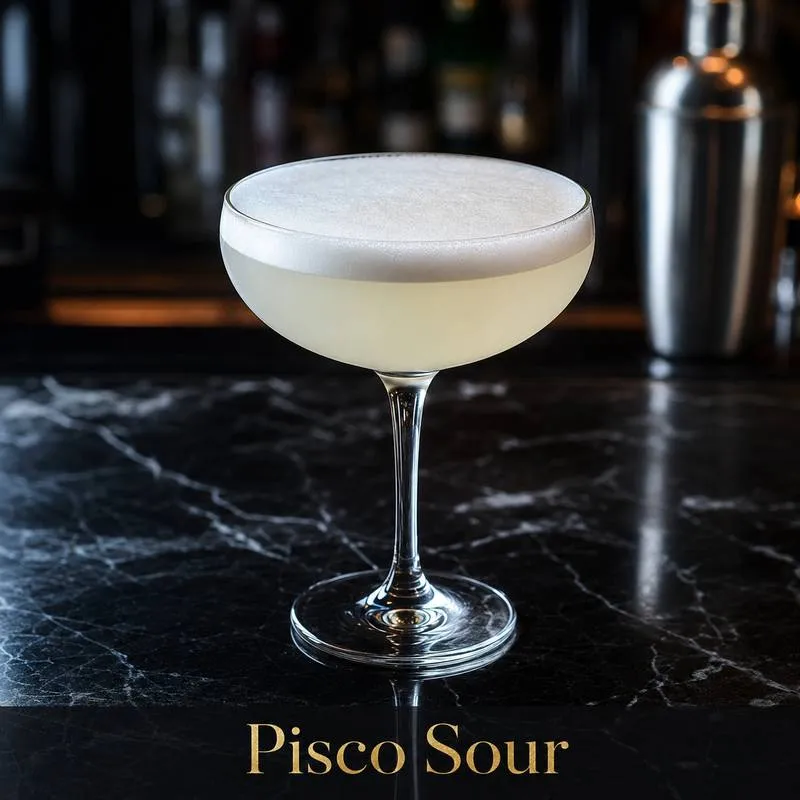
Pisco Sour Cocktail Recipe from Peru
Pronunciation: PEES-koh SOWR · Origin: Peru · Glass: Coupe or Old Fashioned · Difficulty: Intermediate · Strength: about 15% ABV · Serve: Very Cold (0 to 3°C / 32 to 37°F) · Style: Flat · Era: Prohibition · Flavour: Floral, Tart, Silky, Citrusy, Complex
What it tastes like
Clean and vivid: Peruvian pisco’s grape-derived brightness and floral aromatics are sharpened by lime, balanced by simple syrup, and transformed by the egg white foam into a silky, cloud-like texture. The bitters on the foam add a spiced, aromatic nose that changes the experience of every sip.
Ingredients
- 60 ml (2 oz) Peruvian Pisco
- 30 ml (1 oz) Fresh Lime Juice
- 20 ml (0.75 oz) Simple Syrup
- 1 piece Egg White
- 3 dashes Angostura Bitters
Method
- Combine pisco, fresh lime juice, simple syrup, and egg white in a shaker without ice.
- Dry shake vigorously for 20 seconds to fully emulsify the egg white and build a stable foam base.
- Add ice to the shaker and shake again for another 15 seconds until well chilled.
- Double-strain into a chilled coupe or rocks glass.
- Wait 10 seconds for the foam to settle and firm up on the surface.
- Add 3 dashes of Angostura bitters in a small triangle or line on the foam, then use a cocktail pick to drag them into a decorative pattern. This step is traditional and not decorative alone: the bitters add aromatic complexity.
Sourcing the ingredients
Sourcing difficulty: Moderate
Peruvian pisco must be labeled specifically as Peruvian: it is a Denominación de Origen protected product. Quality brands include Barsol, Portón, and Cuatro Gallos; Quebranta and Italia are grape varieties, not brands. Chilean pisco (a different product entirely) produces a different drink. Fresh lime juice is essential. The egg white and bitters drop on the foam are non-optional elements of the authentic preparation.
History
Competing accounts of the Pisco Sour’s origin exist, and none is confirmed. Most accounts credit Victor Vaughen Morris, an American from a Mormon family who went to Peru in the early 1900s to work for a railway company in Cerro de Pasco: he recalled first mixing pisco into a cocktail during the July 1904 celebrations for the railway’s completion, after the whiskey ran out, and in 1916 he opened Morris’ Bar in Lima, where the drink became popular. A Chilean story from the 1980s credits Elliot Stubb, an English steward said to have opened a bar in the then-Peruvian port of Iquique in 1872, but researcher Guillermo Toro-Lira argued that the newspaper source was describing a whiskey sour. Complicating the Morris account, the 1903 Peruvian cookbook Manual de Cocina a la Criolla contains a pisco punch recipe with egg whites. Mario Bruiget, a Peruvian from Chincha Alta who worked at Morris’ Bar from 1924, is credited with adding the egg white foam and Angostura bitters drops: the signature elements that distinguish the Peruvian Pisco Sour from a simple sour.
Pisco Sour Day, celebrated on the first Saturday of February, is a Peruvian national celebration, made official in 2004 by Ministerial Resolution 161-2004-PRODUCE. The Peruvian government has actively promoted the drink internationally as a cultural ambassador, and in 2007 it was declared part of Peru’s National Cultural Heritage.
Cultural significance
The Pisco Sour is Peru’s most powerful cultural symbol in liquid form and the centerpiece of an ongoing international dispute with Chile, both of which produce a grape brandy called ‘pisco’ and both of which claim historical priority. This long-running dispute, which involves competing Denominaciones de Origen, makes the Pisco Sour unique among cocktails as a drink that carries the weight of national identity politics. In Peru the drink is promoted as a symbol of national identity, with its own official national day. The drink’s complex two-shake preparation and the precise bitters pattern on the foam make it one of the most technically demanding and visually impressive classic cocktails in the world.
Food pairings
- Ceviche
- Grilled seafood
- Empanadas
- Anticuchos
Get Meridian
Keep all 888 drinks from 141 countries in one app: search any drink by name, browse by country, filter by flavour, switch between ml and oz and save your favourites. One price, no ads, no account, and it works offline.