 Meridian
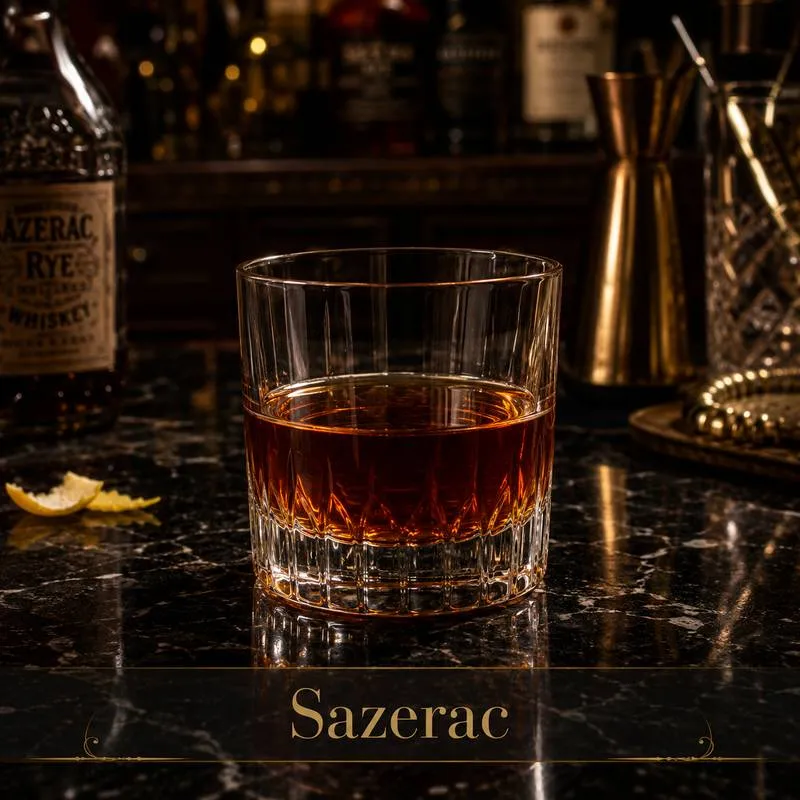
Sazerac Cocktail Recipe from the United States
Pronunciation: SAZ-uh-rak · Origin: United States · Glass: Old Fashioned (Rocks), No Ice · Difficulty: Intermediate · Strength: about 32% ABV · Serve: Cold (4 to 8°C / 39 to 46°F) · Style: Flat · Era: Victorian · Flavour: Anise, Spicy, Boozy, Complex, Aromatic
What it tastes like
Intensely aromatic and spirit-forward: rye whiskey dominates, layered with the anise-and-rose fragrance of Peychaud’s bitters, a ghost of absinthe from the rinse, and a barely perceptible sweetness. The lemon oil on the nose completes the experience. Every sip is different as the drink slowly opens up.
Ingredients
- 60 ml (2 oz) Rye Whiskey
- 3 dashes Peychaud’s Bitters
- 1 dash Angostura Bitters
- 5 ml (0.25 oz) Demerara Simple Syrup
- 5 ml (0.25 oz) Absinthe
- 1 twist Lemon Peel
Method
- Place a rocks glass in the freezer or fill it with ice water to chill it while you prepare the drink.
- In a separate mixing glass, combine rye whiskey, Peychaud’s bitters, Angostura bitters, and demerara syrup with ice.
- Stir for 30 seconds until well chilled.
- Discard the ice (or ice water) from the rocks glass and pour in the absinthe.
- Swirl the absinthe to coat the interior of the glass completely, then discard the excess.
- Strain the stirred whiskey mixture into the absinthe-rinsed glass: no ice.
- Express a lemon peel over the glass and discard it; the Sazerac takes no garnish in the glass.
Sourcing the ingredients
Sourcing difficulty: Moderate
Peychaud’s Bitters are essential: they provide the drink’s distinctive anise-and-floral character and cannot be substituted with Angostura. Absinthe is used only as a rinse; Herbsaint (a New Orleans anise liqueur) is the traditional substitute if absinthe is unavailable. The Sazerac is served in a chilled glass with no ice.
History
The Sazerac is often claimed as the oldest American cocktail, though that claim is not established. Its story begins in New Orleans with Antoine Amédée Peychaud, a Creole pharmacist from the West Indies: according to the Sazerac Company he opened his apothecary on Royal Street in 1834, while the Oxford Companion to Spirits and Cocktails dates the introduction of his bitters to between 1849 and 1857. A popular story says he served drinks in small egg cups called ‘coquetiers’, once claimed as the source of the word ‘cocktail’, though historians treat that as a myth because the word was in print by 1806. According to the account of writer Stanley Clisby Arthur, the drink was originally made with Sazerac de Forge et Fils cognac, and it was served at the Sazerac House, a New Orleans coffee house (bar) beside the Merchants Exchange. Who first made the drink, and when, is not documented. During the phylloxera blight that devastated French vineyards, rye whiskey replaced cognac as the base spirit (the Sazerac Company dates this to 1885). New Orleans’ tourism board credits bartender Leon Lamothe with adding the absinthe in 1873.
According to the Sazerac Company’s own account, its history runs from Thomas Handy’s purchase of the Sazerac House in 1869 to the present day.
Cultural significance
In June 2008, the Louisiana legislature proclaimed the Sazerac the official cocktail of New Orleans: a remarkable act of state-level recognition for a drink. It is the embodiment of New Orleans’ distinctive French Creole culture: its use of absinthe reflects French influence, its rye whiskey reflects American frontier culture, and its Peychaud’s bitters reflect the Caribbean Creole community that shaped New Orleans. The city’s unique status as a place where American, French, Spanish, and Caribbean cultures collided is perfectly expressed in this single glass. The Sazerac has no ice, no garnish, and no compromise: it demands to be taken seriously.
Food pairings
- Pastrami on rye
- Aged cheese
- Charcuterie
- Dark rye bread
Get Meridian
Keep all 888 drinks from 141 countries in one app: search any drink by name, browse by country, filter by flavour, switch between ml and oz and save your favourites. One price, no ads, no account, and it works offline.